





The landscape of subvisible particle analysis continues to evolve as biologics become more complex, delivery systems become more sophisticated, and regulators seek greater harmonization across global pharmacopeias.
Over the last couple of years, we’ve seen important signs of change to subvisible particle monitoring recommendations from the US Pharmacopeia (USP):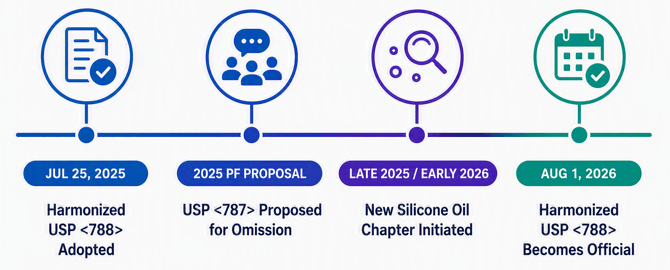
-
July 25, 2025 (announced; effective August 1, 2026): Harmonized USP <788> Adopted: USP published its notice of adoption for the harmonized revision of Chapter USP <788> Subvisible Particulate Matter in Injections.4 The revision introduced greater flexibility in sampling volumes and sampling plans, explicitly included intramuscular (IM) and subcutaneous (SC) injection routes, and completed harmonization with the European and Japanese pharmacopeias. The revised chapter became official on August 1, 2026.1
-
2025 Pharmacopeial Forum Proposal: USP <787> Proposed for Omission: The USP General Chapters–Dosage Forms Expert Committee published a proposal to omit USP <787> Subvisible Particulate Matter in Therapeutic Protein Injections. The briefing states that the harmonized revision of USP <788> now includes methods for therapeutic protein injections, making a separate chapter potentially redundant.2
-
Late 2025/Early 2026: USP Initiates Development of a New Informational Chapter on Silicone Oil Droplets: USP published the Stimuli article Addressing Subvisible Silicone Oil Droplets—Industry Challenges, Analytical Strategies, and USP's Rationale for a New General Informational Chapter, which presents the rationale for creating a new USP informational chapter dedicated to subvisible silicone oil particles, reflecting growing industry attention to this increasingly important particle class.3
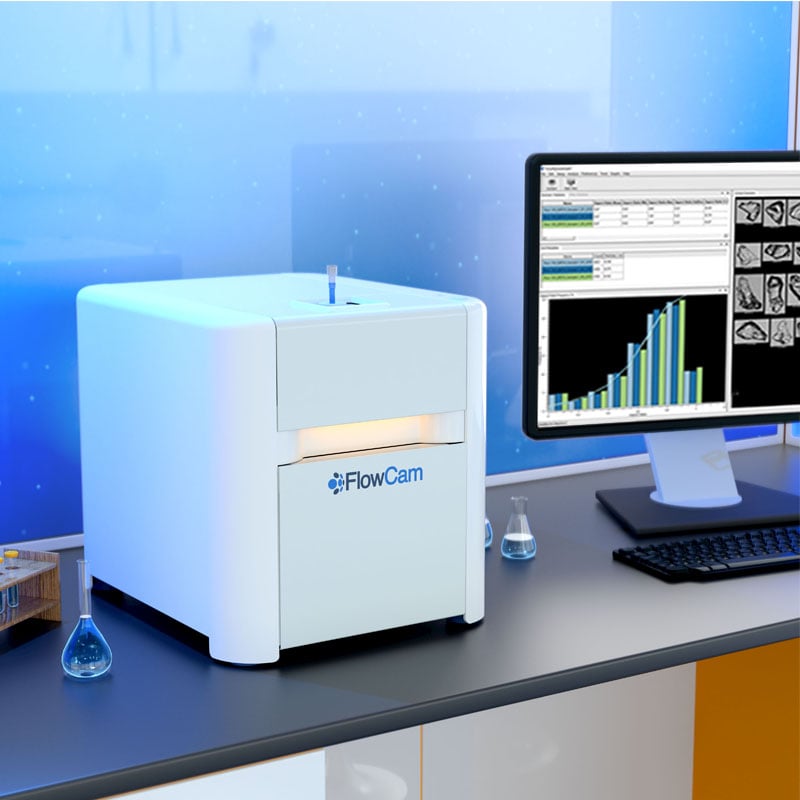
This evolution in standard compendial methodologies signals the end of one-size-fits-all testing. While compendial testing remains essential for lot release and quality control, it is paving the way for orthogonal analytical techniques to transform routine particle counting into deep, visually verified characterization. Chief among these methods is flow imaging microscopy (FIM)—a technique specifically recognized by the USP to analyze particle morphology during drug development, investigations, and risk assessments.
What Changed in the Harmonized USP <788> Revision?
The harmonized revision of USP <788> became official on August 1, 2026, aligning USP with the corresponding requirements in the European Pharmacopoeia (EP 2.9.19) and Japanese Pharmacopoeia (JP 6.07). The chapter, now titled Subvisible Particulate Matter in Injections, remains the primary compendial standard for monitoring subvisible particles in parenteral drug products.
Although the fundamental particle limits and compendial methods remain unchanged, several updates provide greater flexibility for modern biotherapeutics:
-
The scope now explicitly includes intramuscular and subcutaneous injectable products.
-
Single-unit testing is permitted for both small-volume and large-volume parenterals.
-
Products that cannot practically provide the traditional 25 mL test volume may use justified aliquots as small as 1–5 mL.
-
Alternative diluents may be used when scientifically justified.
-
Compliance continues to be assessed using average particle counts across pooled samples.
These revisions are particularly beneficial for high-value biologics, gene therapies, and other products where sample volume is limited. The changes also reduce some of the practical challenges that developers have historically faced when applying USP <788> to low-volume drug products.
Despite this added flexibility, the chapter continues to rely on two compendial methods: light obscuration (Method 1) and microscopic particle count (Method 2). While these methods are well established for quantifying particles, they provide limited information about particle identity and morphology. As a result, additional characterization techniques often play a critical role in understanding the source and significance of detected particles.
What Does the Future Hold for USP <787>?
The harmonized revision of USP <788> may have implications beyond particle-testing workflows. USP has also published a briefing proposing the omission of USP <787>, Subvisible Particulate Matter in Therapeutic Protein Injections (Case ID SUB-2881).2 According to the briefing, the proposal is based on the rationale that "the harmonized <788> has been revised to include methods for therapeutic protein injections, making this chapter redundant."
Historically, USP <787> provided an alternative framework specifically for therapeutic protein products.5 One of its main advantages was the ability to accommodate lower test volumes, a significant consideration for high-value biologics and other products that could not easily meet the traditional testing requirements of USP <788>. However, the harmonized revision of USP <788> now allows justified 1–5 mL aliquots, permits single-unit testing, and includes provisions intended to facilitate testing of protein products.
As a result, some of the distinctions that originally justified a separate chapter for therapeutic protein injections have narrowed considerably. While USP <787> remains in place today, the omission proposal signals USP's view that the revised USP <788> may be sufficient to address both conventional injectable drug products and therapeutic proteins within a single harmonized chapter.
Importantly, the proposed omission of USP <787> does not reduce the need for particle characterization. In many ways, it reinforces the growing importance of the informational chapters USP <1787> and USP <1788>, which continue to recommend orthogonal analytical approaches for understanding the identity, morphology, and origin of subvisible particles in complex biological products.
USP <1787> and USP <1788>: Expanding Particle Characterization Beyond Compendial Testing
As therapeutic proteins, cell therapies, gene therapies, and combination products have become more common, USP's informational chapters have gained importance alongside the traditional compendial tests. USP<1787>, Measurement of Subvisible Particulate Matter in Therapeutic Protein Injections6, recognizes that protein aggregates can be difficult to characterize using traditional methods due to their low refractive index and flexible structures. USP therefore recommends the use of multiple complementary and orthogonal analytical techniques to better understand particle populations.
Similarly, USP <1788>, Methods for the Determination of Subvisible Particulate Matter7, provides practical guidance on implementing various particle analysis techniques and includes a dedicated section, USP <1788.3>, focused on flow imaging microscopy. The inclusion of FIM alongside established methods reflects the growing recognition that particle morphology can provide important insights that particle counts alone cannot.
Unlike light obscuration, which reports particle size and concentration based on optical blockage, flow imaging microscopy captures images of individual particles while they remain suspended in solution. This allows researchers to evaluate particle shape, transparency, and morphology, providing valuable information about particle origin and composition.
Why Silicone Oil Droplets Are Receiving Increased USP Attention
One of the most noteworthy recent developments is USP's Stimuli article that sought feedback on creating a new informational chapter dedicated to subvisible silicone oil droplets (SiOPs). Silicone oil is widely used as a lubricant in prefilled syringes and many other drug delivery devices. Over time, silicone oil can migrate from device surfaces into the drug product, forming droplets that may be detected as subvisible particles.
As biologics increasingly shift from vials to prefilled syringes and autoinjectors, manufacturers are encountering more situations where SiOPs contribute significantly to overall particle counts. In some cases, SiOPs may even cause products to approach or exceed compendial limits measured by light obscuration.
The analytical challenge is that compendial methods are not designed to distinguish SiOPs from other particle types. Light obscuration can detect and count SiOPs but cannot determine their identity. Membrane microscopy can be even more problematic because SiOPs may deform, pass through filter pores, or be poorly retained during filtration.
At the same time, current scientific understanding suggests that SiOPs represent a distinct category of particles with different safety considerations than protein aggregates or foreign particulate contaminants. The USP stimuli article notes that silicone oil itself has a long history of clinical use and appears to have relatively low toxicity.3 However, interactions between SiOPs and proteins remain an area of active study, particularly because silicone oil can influence protein aggregation and create mixed particle populations.
This combination of analytical complexity and clinical relevance has prompted USP to explore the development of a dedicated informational chapter addressing characterization strategies, risk assessment approaches, control strategies, and specification setting for SiOPs.
How Flow Imaging Microscopy Supports USP Particle Analysis Recommendations
A recurring theme throughout both USP <1787> and the silicone oil Stimuli article3 is the importance of orthogonal particle characterization. Flow imaging microscopy is frequently highlighted because it enables direct visualization of particles in their native liquid environment.
Researchers can often distinguish SiOPs from protein aggregates based on morphology alone. SiOPs typically appear spherical, whereas protein aggregates tend to exhibit more irregular or amorphous shapes. USP specifically notes that morphology-based image analysis can be used to differentiate these particle populations.
The value of this morphological information extends beyond simple classification. Understanding whether elevated particle levels arise from protein aggregates, SiOPs, container-closure interactions, or foreign contaminants can significantly improve root cause investigations and facilitate more effective risk assessments.
The stimuli article also highlights the growing role of artificial intelligence and machine learning in particle characterization.3 AI-based image analysis tools are increasingly being used to automate the classification of SiOPs, protein aggregates, and other particle types using images generated by flow imaging systems. These emerging approaches may further enhance the utility of morphology-based particle analysis as regulatory expectations continue to evolve.
Preparing for the Future of Subvisible Particle Characterization
The 2026 harmonization of USP <788> provides greater flexibility for modern injectable products while preserving the established framework for compendial particulate matter testing. At the same time, USP's growing focus on SiOPs signals a broader shift toward more sophisticated particle characterization strategies.
For pharmaceutical scientists, the message is clear: particle counts remain essential, but understanding particle identity is increasingly important. As biologics, gene therapies, and advanced delivery systems continue to evolve, orthogonal analytical techniques such as flow imaging microscopy can provide critical information that complements traditional compendial methods.
By combining quantitative particle measurements with morphological characterization, manufacturers can gain deeper insight into particle populations, strengthen root cause investigations, and prepare for future USP recommendations regarding particle characterization, including the potential future guidance on subvisible SiOPs.
To learn more, read our white paper, "USP Reference Standards for Subvisible Particulate Matter: Setting Guidelines for the Development of Safe and Effective Biotherapeutics".
References
-
United States Pharmacopeia. Particulate Contamination. Notice of Adoption of Harmonized Standard. Published July 25, 2025; official August 1, 2026.
-
United States Pharmacopeial Convention. <787> Subvisible Particulate Matter in Therapeutic Protein Injections. Pharmacopeial Forum proposal for omission (Case ID SUB-2881).
-
Saggu M, Kwok SC, Narhi LO, Zhang B, Minocha S, Pombo M, Hunt DG. Addressing Subvisible Silicone Oil Droplets—Industry Challenges, Analytical Strategies, and USP's Rationale for a New General Informational Chapter. Pharmacopeial Forum. Stimuli article.
-
United States Pharmacopeia. USP <788> Subvisible Particulate Matter in Injections.
-
United States Pharmacopeia. USP <787> Subvisible Particulate Matter in Therapeutic Protein Injections.
-
United States Pharmacopeia. USP <1787> Measurement of Subvisible Particulate Matter in Therapeutic Protein Injections.
-
United States Pharmacopeia. USP <1788> Methods for the Determination of Subvisible Particulate Matter.
-
United States Pharmacopeia. USP <789> Particulate Matter in Ophthalmic Solutions.