


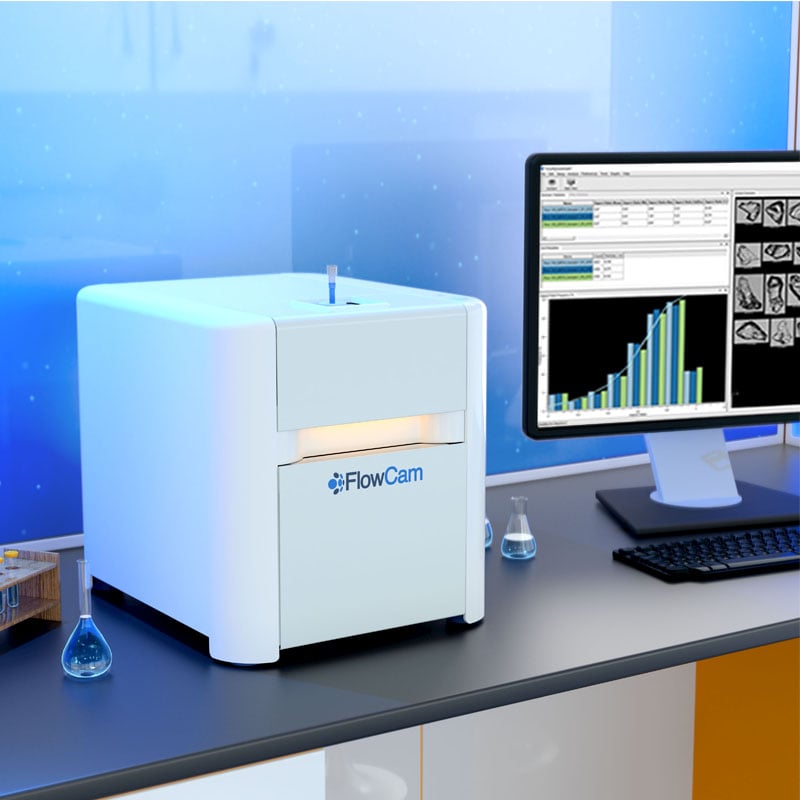


 Voted one of the "Best Places to Work in Maine" for the eighth year, we are looking for talented professionals to join our rapidly growing team. With our innovative FlowCam technology and artificial intelligence platform, Yokogawa Fluid Imaging Technologies is the global leader in flow imaging microscopy solutions for the Life Sciences industry. We make meaningful differences in the world by helping scientists develop new and safer pharmaceutical products, improve the quality of drinking water, and assist researchers in their understanding of marine and freshwater systems, among many other uses.
Staff Engineer
About the Role:
We are seeking a versatile, hands-on, experienced Staff Engineer to design, integrate, test, and improve multidisciplinary electromechanical products and manufacturing systems. The ideal candidate has a strong foundation in mechanical engineering, practical experience with electrical hardware, and a strong interest in product development, manufacturing, rapid prototyping, and experimental problem-solving.
This position bridges component-level engineering, manufacturing, and complete-system performance. This senior level engineer will convert requirements and early concepts into CAD designs, prototype assemblies, production-ready documentation, test methods, and validated hardware. This experienced Staff Engineer opportunity is well suited to someone who enjoys moving between SolidWorks, the laboratory, fabrication tools, electronics, manufacturing operations, data analysis, and collaborative problem-solving.
Primary Duties and Responsibilities:
- Mechanical Design and Manufacturing
- Design mechanical components, assemblies, fixtures, and instrument packaging using SolidWorks or a comparable professional CAD platform.
- Develop practical solutions for structural support, enclosures, mechanisms, fluidics, thermal management, cable routing, operator access, assembly, and service requirements.
- Create production-ready models, drawings, bills of material, tolerance schemes, and assembly documentation.
- Apply design-for-manufacturing, design-for-assembly, and design-for-service principles to prototype and released hardware.
- Collaborate with machine shops, sheet metal suppliers, additive manufacturing vendors, and internal manufacturing personnel to obtain and improve parts.
- Evaluate material selection, fits, fasteners, threaded interfaces, tolerance stack-up, stiffness, thermal expansion, vibration, and mechanical reliability.
- Manufacturing and Production Support
- Develop manufacturing processes, assembly sequences, fixtures, gauges, work instructions, and production test methods for electromechanical products.
- Partner with manufacturing, quality, supply chain, and suppliers to resolve part, assembly, yield, reliability, and service issues.
- Support supplier selection, quotation review, manufacturability feedback, first-article inspection, pilot builds, and production readiness.
- Investigate nonconformances and production failures using structured root-cause methods, then implement and verify corrective actions.
- Improve designs and processes to reduce cost, assembly time, variability, rework, and dependence on specialized operator knowledge.
- Create clear specifications and acceptance criteria for purchased parts, fabricated components, assemblies, and completed systems.
- Electrical and Electromechanical Integration
- Integrate sensors, motors, actuators, switches, power supplies, cables, connectors, safety devices, and basic control hardware into electromechanical systems.
- Read and work from electrical schematics, wiring diagrams, connector pinouts, data sheets, and interface-control documentation.
- Perform basic electrical measurements and troubleshooting using equipment such as digital multimeters, oscilloscopes, and bench power supplies.
- Create or modify prototype wiring, cable assemblies, interconnects, and simple test setups in collaboration with electrical and software engineers.
- Identify grounding, shielding, power, heat, signal-integrity, connector, and cable-management risks and escalate specialized electrical design needs appropriately.
- Support bring-up and troubleshooting of integrated electromechanical assemblies.
- Rapid Prototyping and Experimental Development
- Rapidly convert concepts, sketches, and evolving requirements into functional prototypes and testable hardware.
- Use 3D printing, machining, sheet metal, laser-cut parts, commercial components, and other fabrication methods as appropriate to the engineering question.
- Operate or support additive manufacturing workflows, including CAD preparation, slicing, material selection, post-processing, dimensional inspection, and design iteration.
- Design test fixtures, alignment aids, adapters, jibs, and temporary instrument modifications that improve experimental speed and repeatability.
- Determine when a quick prototype is sufficient and when the application requires precision machining, controlled materials, or a production-grade design.
Required Qualifications:
- Bachelor's degree in Mechanical Engineering, Mechatronics, Systems Engineering, Electromechanical Engineering, Engineering Physics, or a related technical field, or equivalent relevant experience.
- Professional experience designing mechanical parts and assemblies in SolidWorks, including drawings, configurations, assemblies, and design revisions.
- Working knowledge of manufacturing processes such as machining, sheet metal, injection molding, additive manufacturing, and assembly.
- Experience developing prototypes and working effectively with incomplete or evolving requirements.
- Strong technical documentation, organization, communication, and cross-functional collaboration skills.
- ISO9001 compliance processes – OFIs, CARs.
Preferred Qualifications:
- Master's or Ph.D. in Engineering focus.
- Experience developing assembly processes, manufacturing, fixtures, work instructions, inspection methods, or production test equipment.
- Hands-on experience with 3D printing and rapid-prototyping materials, processes, and post-processing methods.
- Experience with tolerance analysis, GD&T, thermal design, vibration, structural analysis, or finite-element analysis.
- Experience using Python, MATLAB, Excel, ImageJ, or similar tools for data analysis, visualization, automation, or image analysis.
- Experience developing laboratory, analytical, medical, industrial, or other regulated or quality-controlled instruments.
- Experience transferring designs from prototype through verification and into manufacturing.
Work Environment:
This is a hands-on engineering role involving regular work with CAD software, electronics, prototype fabrication equipment, hand tools, dimensional and electrical measurement equipment, 3D printers, production hardware, and electromechanical assemblies. Appropriate training, engineering controls, and personal protective equipment will be used where required.