




All biotherapeutics contain particulate matter, defined by the United States Pharmacopeia (USP) as mobile undissolved particles that are unintentionally present in the drug product solution. Particulate matter includes subvisible particles, generally described as particles between 2 and 100 µm in diameter. Subvisible particles in biologics have been associated with changes in product safety and efficacy, including adverse reactions ranging from capillary occlusion to immune responses.
To mitigate these risks, USP <788>1, <787>2, and <789>3 establish limits for the subvisible particle content of parenteral drug products. The table below summarizes these requirements. This post introduces the three chapters and discusses how FlowCam, a flow imaging microscope, can provide orthogonal particle characterization alongside compendial testing.
2026 update: A harmonized revision of USP <788> became official on August 1, 2026. Among other changes, the revised chapter permits single-unit testing and allows justified 1–5 mL aliquots when a product cannot provide the default 25 mL test volume. For a full explanation of the revision, read USP Particle Chapter Updates and the Growing Role of FlowCam.
Download the White Paper: USP Reference Standards for Subvisible Particulate Matter

Table 1. Summary of the particulate matter requirements in USP <787>, <788>, and <789>. Under the harmonized revision of USP <788>, the default test volume remains 25 mL, but justified 1–5 mL aliquots may be used for products that cannot provide sufficient test volume.
USP <788> Subvisible Particulate Matter in Injections
USP <788> is the most broadly applicable of the three chapters because it applies to all parenteral drug products. The harmonized revision explicitly includes products administered by the intramuscular and subcutaneous routes, the latter an area of growing relevance. The chapter is harmonized with European Pharmacopoeia 2.9.19 and Japanese Pharmacopoeia 6.07. Although it is specific to monitoring particles in pharmaceutical products, particle shedding from medical devices such as syringes, infusion pumps, and implantable devices is also often evaluated using this standard.
To meet the requirements of USP <788>, the subvisible particle content of each drug product batch must be tested as part of lot release and quality control. While the default test volume is 25 mL, the harmonized revision permits justified 1–5 mL aliquots for products that cannot provide sufficient test volume. Single-unit testing is also permitted for both small- and large-volume parenterals.
Two compendial methods are specified: light obscuration, or Method 1, and microscopic particle count (also commonly called membrane microscopy), or Method 2. Light obscuration is preferred under most circumstances because of its ease of use and in-solution measurement. The applicable particle limit depends on the drug product volume. Products containing no more than 100 mL must contain no more than 6,000 particles ≥10 µm and 600 particles ≥25 µm per container when tested using light obscuration.
Membrane microscopy is used when light obscuration is unsuitable for a particular drug product, such as a product with high viscosity or limited transparency. For products containing no more than 100 mL, the sample must contain no more than 3,000 particles ≥10 µm and 300 particles ≥25 µm per container when tested using Method 2. Under either method, where multiple units are pooled for testing, compliance is assessed using the average number of particles across the pooled sample rather than requiring each individual unit to meet the limit.
The two methods use different measurement principles and therefore have different acceptance criteria. Filtration and sample preparation for microscopic particle counting can also affect fragile or deformable particle populations, including protein aggregates and silicone oil droplets. Results from the two methods should therefore be interpreted according to the method used.
USP <787> Subvisible Particulate Matter in Therapeutic Protein Injections
Although USP <788> applies broadly to injectable drug products, it was originally developed for small-molecule therapies. As protein therapeutics became more common, a need emerged for subvisible particle monitoring strategies tailored to protein drug products and the particular analytical challenges they present.
Protein therapeutics may contain subvisible protein aggregate particles. These particles can be difficult to analyze using membrane microscopy because their fragile, “soft” structures may be altered or lost during sample preparation and filtration. Many protein therapies are also supplied in relatively small volumes.
USP <787> provides an alternative approach for evaluating subvisible particles in therapeutic protein injections. Like USP <788>, it uses the light obscuration method and applies the same particle limits. However, USP <787> includes procedures tailored to protein formulations, with specific guidance for sample handling, mixing, and degassing. Rather than requiring a fixed test volume, the chapter allows testing to be scaled based on the amount of product available. Multiple aliquots are analyzed, the first measurement is discarded, and compliance is determined using the average particle count from the remaining measurements. USP <787> also discusses membrane microscopy but notes that results obtained by this method are not equivalent to those from light obscuration and should not be considered interchangeable, particularly because some protein particles may be fragile or translucent.
Historically, sample-volume flexibility was an important distinction between USP <787> and USP <788>. That distinction has narrowed under the harmonized revision because USP <788> now permits justified 1–5 mL aliquots and single-unit testing. USP <787>, however, remains specifically focused on therapeutic protein injections.
USP has since published a briefing proposing to omit <787> altogether, on the basis that the harmonized <788> now includes methods for therapeutic protein injections, making the chapter redundant (Case ID SUB-2881). USP <787> remains in place today, and testing to it remains valid unless and until the proposal is finalized.
USP <789> Particulate Matter in Ophthalmic Solutions
USP <789> is specific to ophthalmic drug products delivered by intraocular routes, including intravitreal and subretinal administration. Extraocular injectable drug products also require subvisible particle monitoring but are subject to USP <788> rather than USP <789>. More information about which chapter applies to a particular ophthalmic delivery route is available in USP <771>.
Subvisible particles can affect ophthalmic drug products by causing patients to see floaters following administration. Intraocular ophthalmic products are therefore subject to more stringent particle limits than other parenteral products. These products must contain no more than 50 particles/mL ≥10 µm, 5 particles/mL ≥25 µm, and 2 particles/mL ≥50 µm, regardless of sample volume or testing method.
Because these limits are expressed on a per-volume basis, small-volume ophthalmic products must contain fewer particles per container than many other parenteral products of the same volume.
How Flow Imaging Microscopy Relates to USP <787>, <788>, and <789>
Flow imaging microscopy (FIM) is not one of the compendial methods specified in USP <787>, <788>, or <789>. Researchers will generally use one of the compendial techniques, most often light obscuration, as the primary lot-release assay. Using a non-compendial method as an alternative primary test would require appropriate demonstration of its suitability for the intended application.
FIM is recommended as an orthogonal characterization technique in USP informational chapters <1787>4 and <1788>5. USP <1788.3> provides specific guidance for flow imaging measurements. Unlike methods that report particle size and concentration without images, FIM captures images of individual particles in solution and provides morphological measurements that can help researchers investigate particle type and source.
FlowCam measurements can support development, quality control, and root cause investigations when a sample produces an unexpected particle count or fails a compendial test. Images of detected particles may help determine whether a change is associated with protein aggregates, silicone oil droplets, fibers, process-derived particles, or another particle population. This information can support investigation of the underlying source and help researchers monitor particle populations across batches.
For a more detailed discussion of the role of flow imaging microscopy in the USP informational chapters, read our article on recommendations from USP <1787> and USP <1788>.
Combining Light Obscuration and Flow Imaging Microscopy
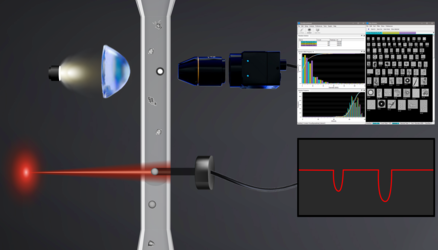
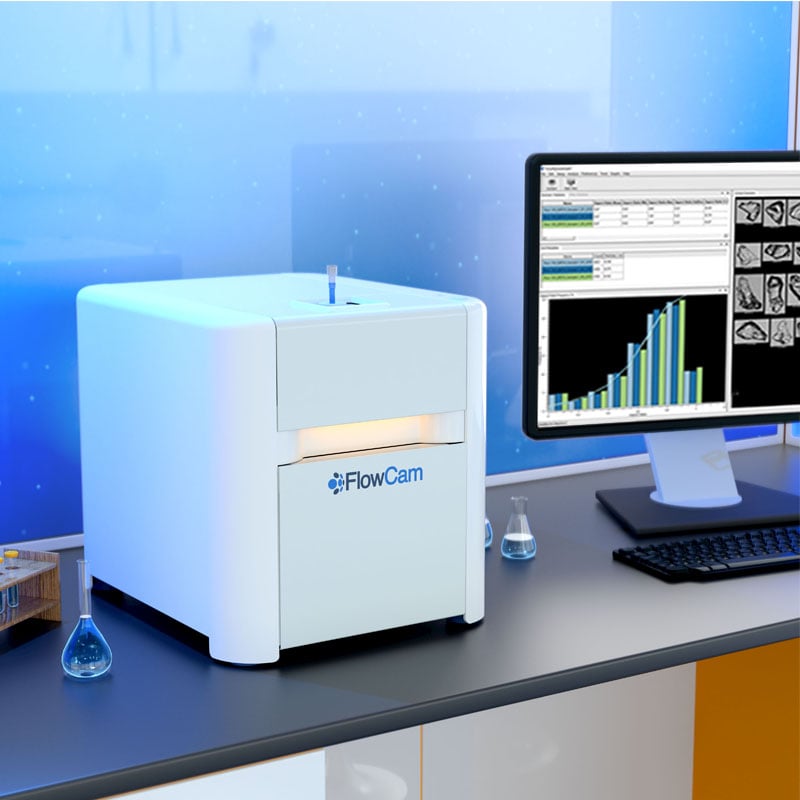
FlowCam LO combines light obscuration and flow imaging microscopy in a single instrument. It collects LO measurements together with particle images and morphological data from the same sample flow path, without requiring a separate sample aliquot for imaging.
This combined approach allows researchers to perform light obscuration measurements while also collecting orthogonal information that can assist with particle characterization. Depending on the validated analytical workflow, the resulting data may support product development, process monitoring, stability programs, and investigations of unexpected particle populations. ALH for FlowCam can also automate LO measurements and support consistent sample handling.
Choosing the Appropriate USP Chapter
USP <787>, <788>, and <789> establish requirements intended to limit subvisible particulate matter in parenteral drug products. USP <788> applies broadly to injectable drug products, USP <787> is specifically designed for therapeutic protein injections, and USP <789> establishes requirements for ophthalmic solutions administered by intraocular routes. As noted above, USP <787> has been proposed for omission on the basis that the harmonized <788> now addresses therapeutic protein injections; it remains in effect unless and until that proposal is finalized.
The harmonized revision of USP <788> introduces greater sampling flexibility while retaining light obscuration and microscopic particle counting as its compendial methods. Flow imaging microscopy can complement these methods by providing particle images and morphological measurements that help researchers investigate particle identity and source.
To learn more about flow imaging microscopy and USP recommendations, explore the FlowCam resources on our website, including the FlowCam LO brochure and our white paper on orthogonal and complementary particle-analysis methods.
References
- United States Pharmacopeia. USP <788> Subvisible Particulate Matter in Injections. Harmonized revision official August 1, 2026. Available from: USP Particulate Contamination Harmonization Standard.
- United States Pharmacopeia. USP <787> Subvisible Particulate Matter in Therapeutic Protein Injections.
- United States Pharmacopeia. USP <789> Particulate Matter in Ophthalmic Solutions.
- United States Pharmacopeia. USP <1787> Measurement of Subvisible Particulate Matter in Therapeutic Protein Injections.
- United States Pharmacopeia. USP <1788> Methods for the Determination of Subvisible Particulate Matter.