





If you’ve ever searched for clarity on the terminology and acronyms surrounding subvisible particle (SVP) analysis in biopharmaceutical products, this guide is designed to help.
Here, we focus specifically on the 2 – 100 µm SVP range addressed in key USP general and informational chapters. We define the core analytical methods (FIM, LO, MM), clarify particle and measurement terminology, and refer to the relevant USP chapters—highlighting where Flow Imaging Microscopy (FIM) fits within modern regulatory expectations and root cause investigations.
Analytical Methods for Subvisible Particulate Characterization
Compendial Methods: Light Obscuration and Membrane Microscopy
Before diving into the world of imaging, it is essential to understand the two "classic" compendial methods defined by USP <787> and <788>. Light obscuration (LO) is preferably applied (Method 1), quantifying SVPs by the amount of light they block as they pass through a sensor, reported as ESD (Equivalent Spherical Diameter). While LO serves as the regulatory baseline for counting, it often leaves a "data gap" in particle morphology - a gap that Flow Imaging Microscopy is uniquely equipped ot fill.
For samples that are too viscous or opaque for light to pass through, the microscopic particle count or membrane microscopic method (MM) serves as the compendial alternative (Method 2). In this method, particles are captured on a filter and analyzed under a microscope. While MM provides visual data, the process can be slow and laborious; furthermore, sample handling can bias results if not carefully controlled.
Recommended Orthogonal Method: Flow Imaging Microscopy
Flow Imaging Microscopy (FIM) is a technique in which particles in a liquid sample flow through an optical path illuminated by an LED light source and are captured by a camera at high shutter speeds. Unlike static microscopy, FIM captures statistically significant volumes of sample in their native liquid state, making it particularly valuable for detecting rate but clinically relevant events, such as large protein aggregates.
FIM provides:
- Particle concentration
- Image-based size measurements (ESD/ABD/Feret sizing) and size distribution
- Morphological (shape) data for each individual particle to enable identification of particle type
USP Chapters Relevant to SVP Analysis
USP documents are referred to as chapters. Three-digit chapters are compendial chapters (mandatory requirements), while four-digit chapters are informational (general guidance and recommendations). The following chapters are most often referenced regarding SVP analysis in biotherapeutics:
USP <788>: Particulate Matter in Injections - This is the primary compendial chapter governing regulatory acceptance criteria. It defines "subvisible particulate matter" as mobile, undissolved particles (other than gas bubbles) unintentionally present in a drug product. Pass/fail limits for injections are ≥10 µm and ≥25 µm, and establish different approaches for small-volume injections (≤100 mL) vs. large-volume injections (>100 mL). The pending Stage 4 Harmonization (effective August 1, 2026) clarifies that LO (Method 1) and MM (Method 2) measure different characteristics and are not interchangeable (results are not equivalent).
USP <787>: Subvisible Particulate Matter in Therapeutic Protein Injections - Emphasis on therapeutic proteins and reduced sample volumes/pooling strategies.
USP <789>: Particulate Matter in Ophthalmic Solutions - Requires similar test logic to <788> with an added ≥50 µm threshold.
USP <1787>: Measurement of Subvisible Particulate Matter in Therapeutic Protein Injections - An informational chapter focused on characterization and root cause analysis. It supports the use of orthogonal techniques, such as Raman spectroscopy, Electron microscopy, and FIM, to distinguish protein aggregates from silicone oil.
USP <1788>: Methods for the Determination of Particulate Matter in Injections and Ophthalmic Solutions - This chapter expands on analytical techniques beyond LO. USP <1788.3> explicitly recognizes FIM for ~2–100 µm, describing images, particle concentration/PSD, ESD or Feret sizing, and morphology-based categorization (e.g., fibers, bubbles, circular silicone oil droplets, amorphous protein particles).
Why It’s Important to Incorporate Guidance from USP <1788>
In the 2–100 µm SVP range, counting alone is often insufficient. Although LO and/or MM data are typically all that is technically required for drug approvals, regulators increasingly expect:
-
Morphological characterization of particles
-
Particulate source identification
-
Transparency analysis
-
Orthogonal confirmation of data
While Method 1 (LO) is preferably applied in USP <788>, FIM provides critical contextual data that supports investigations, especially when distinguishing:
-
Silicone oil vs. protein aggregates
-
Intrinsic vs. inherent particles
-
Opaque vs. highly transparent aggregates
Definitions: Particle Classification Tiers/Particle Types
While USP <788> tells you if your product is clean enough for the market, USP guidance (<1787>, <1788>) provides the framework for Root Cause Analysis (RCA) and categorizes particles into three tiers based on their origin, which helps manufacturers determine if a particle represents a stability issue, a manufacturing flaw, or a cleanroom breach. These tiers include:
-
Inherent Particles: Particles that are “inherent” to the drug formulation,
Example: Protein Aggregates
These critical particles form from the drug substance itself under stress, temperature changes, or aging. They can impact drug efficacy and immunogenicity. When imaged using FIM, protein aggregates typically appear “wispy” or “stringy” and are often highly transparent. -
Intrinsic Particles: Particles introduced by manufacturing or packaging.
Examples: Silicone Oil Droplets
Silicone oil, used in prefilled syringes, can form subvisible silicone oil particles or droplets (SiOPs), posing unique analytical and clinical challenges. A recent USP Stimuli article noted FIM as a key orthogonal tool for SiOP analysis, as it enables differentiation of SiOPs from protein aggregates using morphology filters (e.g., aspect ratio).
Other examples of intrinsic particles include rubber stopper fragments and stainless steel particles. -
Extrinsic Particles: Foreign contaminants not associated with the formulation or packaging process.
Examples: Cellulose/Fibers from clothing, wipes, or cardboard packaging, Environmental Dust including mineral or organic matter from the air, Skin Cells/Hair from human operators.
LO alone cannot distinguish between inherent, intrinsic, and extrinsic particles, nor does it allow the operator to identify particle type. This is why USP <1788> recommends FIM to identify particle type and the root cause of particulate shedding or aggregation.
Definitions: Size & Morphology Measurements
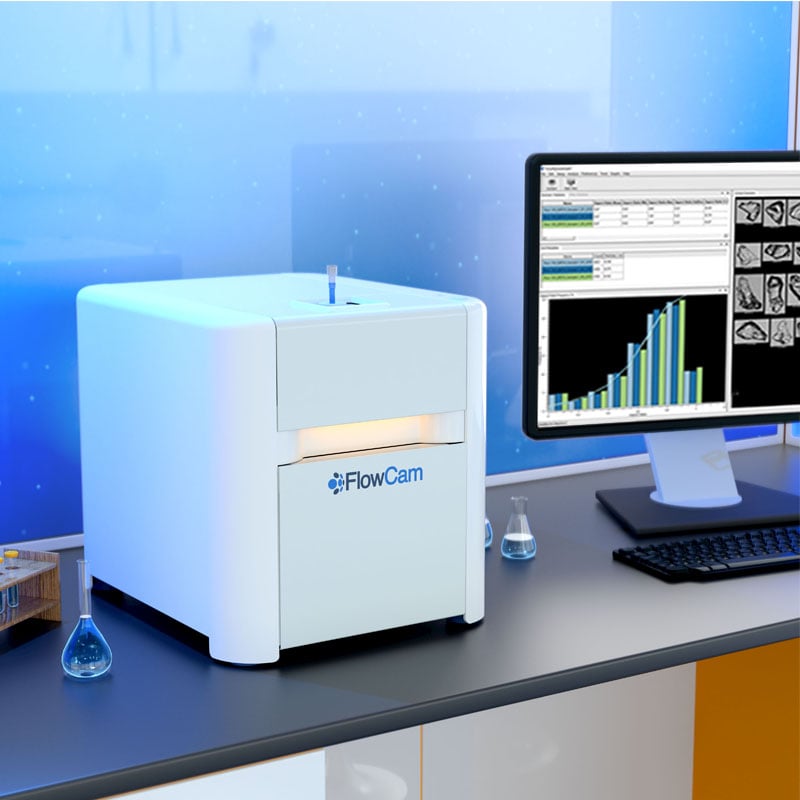
FlowCam, an FIM instrument widely adopted by biologics development teams, offers a variety of standardized mathematical models to quantify size. These include:
-
ABD (Area-Based Diameter): The diameter of a circle with the same area as the 2D particle image, calculated by the total number of pixels.
-
Feret Diameter: The distance between two parallel lines used to determine particle length and width
Because most particles are not perfect spheres, image-based sizing often differs from light-blockage-based sizing. In LO, which uses ESD measurements, transparent or translucent particles that do not fully block the light are often undersized.
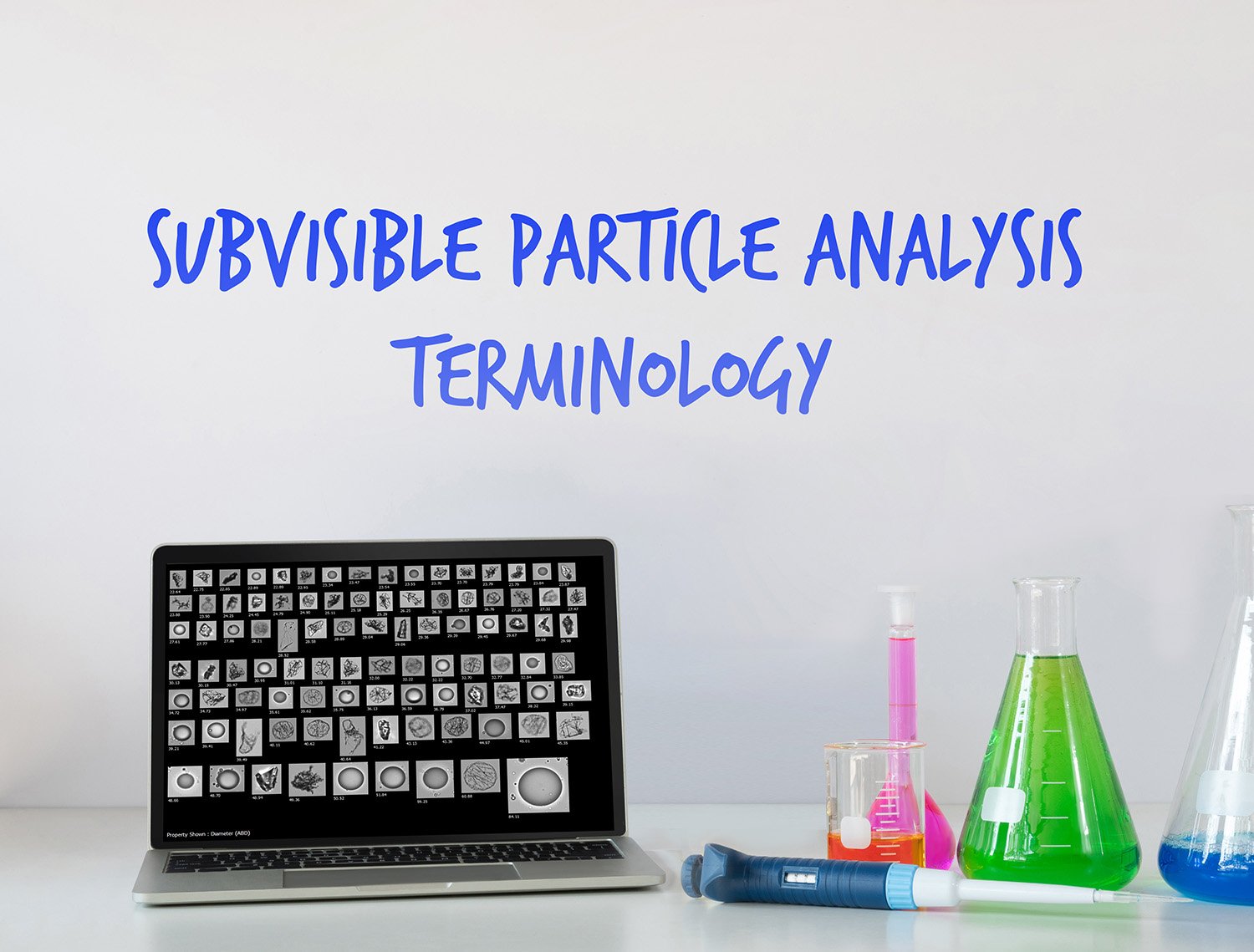
In addition to more accurate size reporting, morphological descriptors are a key advantage of FIM over LO. These parameters are essential for distinguishing between different particle types (like spheres vs. fibers) and are frequently cited in USP <1788.3> as the key advantage of FIM. FlowCam provides a large variety of quantitative shape measurements that can be used together to identify particle type, including:
-
Aspect Ratio: The ratio of the width to the length of the particle. A perfect circle or square has an Aspect Ratio of 1.0. A long, thin fiber will have an Aspect Ratio closer to 0.
-
Circularity: How close is the shape of the 2D particle to that of a perfect circle, based on its perimeter and area.
-
Convexity: The roughness or smoothness of the edge of the particle. This can be used to differentiate dense, solid contaminants from loose, “wispy” protein aggregates.
-
Geodesic Measurements: Calculations of length and width that account for the arcing of particles like fibers, thus providing a more accurate representation of fiber length and width than Feret measurements.
Integrating LO and FIM: Introducing FlowCam LO
For labs seeking to satisfy both compendial requirements and characterization needs, FlowCam LO provides a singular, powerful solution. By combining FIM and LO into a single fluid path, FlowCam LO combines deep morphological information with supporting measurements aligned with USP <788> Method 1. This "best of both worlds" approach lets you determine whether your product meets compendial requirements for regulatory filing while simultaneously identifying the root cause of any particulate matter—all from a single sample run.
Further Reading
For deeper insight into compendial expectations and reference standards, please check out our white paper:
USP Reference Standards for Subvisible Particulate Matter