







As the summer heats up, communities across the United States are cooling off and having fun on the water. Canoeing, kayaking and paddleboarding are popular activities here in Maine, a state which also hosts iconic do-it-yourself (DIY) boat races like the Damariscotta Pumpkinfest & Regatta, where competitors carve boats out of massive pumpkins and race them in front of thousands of spectators.
Many communities around the country host similar DIY races where participants build their own boats from cardboard, recycled materials, or other low‑cost supplies and race them across a short stretch of water. The fun comes from the fact that most builders aren’t engineers, the materials are intentionally limiting, and the results are wildly unpredictable: some boats glide smoothly, others spin in circles, and many sink spectacularly.
When Harmful Algae Blooms Threaten Recreational Water Quality
DIY boat races are supposed to be fun-filled, carefree events, but the proliferation of harmful algal blooms (HABs) can force last‑minute cancellations and turn beloved community traditions into public‑health headaches.
Such was the case for the City of Northglenn, Colorado, which in 2024 had to quickly replace its annual Pirate Fest Regatta with a shoreside event due to “unfavorable conditions” caused by a HAB. When the city broke the news on social media, residents were quick to point out that the regatta’s location—Webster Lake—had struggled with “slime” for years and asked the city to do something about it.
So they did.
Monitoring the Impact of HAB Control Technologies with FlowCam
The city investigated HAB control technologies to help make Webster Lake safe for local “pirates” to race again. The city partnered with Nano Infusion Technologies (NIT), maker of a water treatment product called Aquaritin Lakes & Ponds which is specially formulated to promote diatom growth so that they out-compete cyanobacteria.
To monitor conditions pre- and post-treatment, the team utilized AlgaeTracker buoys to monitor water quality parameters like chlorophyll, and FlowCam Cyano to characterize the plankton community pre- and post-treatment.
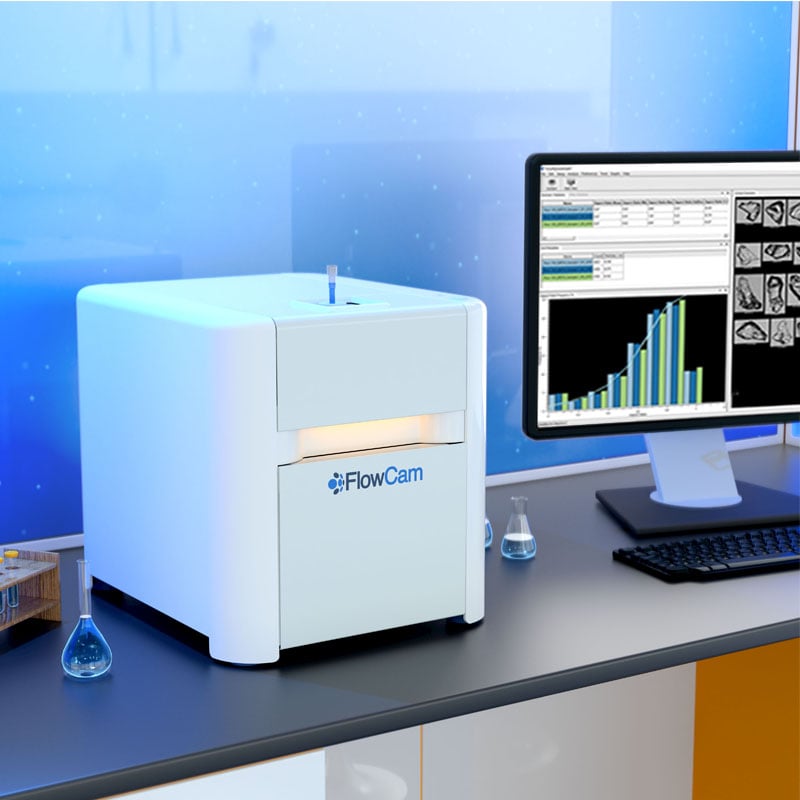
FlowCam Cyano is a water quality analyzer that rapidly images, counts and measures algae and automatically calculates the proportion of cyanobacteria based on fluorescence.
High-Speed Imaging Confirms Shift from Cyanobacteria to Diatoms
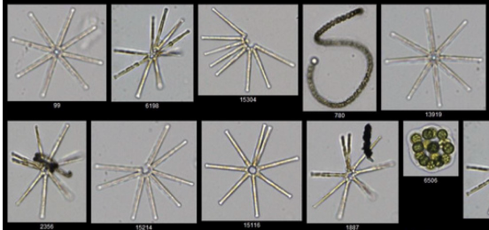
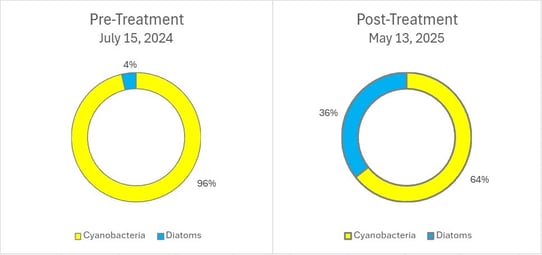 Using FlowCam Cyano, the team could visualize the plankton community’s shift from cyanobacteria to diatoms post-treatment. After treatment, NIT reported an 80-95% reduction in cyanobacteria counts across the three monitoring sites using FlowCam imaging. Pre-treatment water samples were dominated by cyanobacteria like Aphanizomenon and Microcystis, and post-treatment samples were dominated by diatoms like Asterionella (pictured here, in FlowCam 10X images from a post-treatment sample from Webster Lake). Treatment of Webster Lake resulted in a remarkable decrease in cyanobacteria and increase in diatoms from 96% to 64% and from 4% to 36%, respectively.
The city has been very happy with the impact NIT’s treatment has had so far. “The results were truly impressive,” according to Environmental Manager Tami Moon. “After just four applications, we’re thrilled with the outcome and can’t wait to continue this approach in the spring!”
The authors of the case study emphasized the need for water quality monitoring tools like FlowCam that can keep pace with cyanobacteria and diatom production, facilitating more intensive lake monitoring.
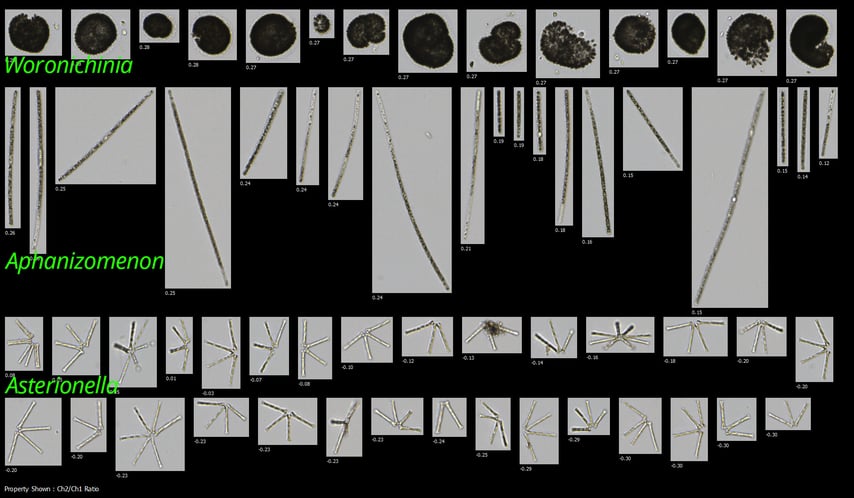
Pictured above: FlowCam Cyano automatically images and measures organisms in sample. In this case study, users sorted by the ratio of phycocyanin (Channel 2) to chlorophyll (Channel 1) to separate cyanobacteria like Woronichinia (top row) and Aphanizomenon (second row) from diatoms like Asterionella (bottom 2 rows).
As new treatment technologies emerge to combat cyanobacterial blooms, high-speed imaging tools like FlowCam provide essential visual verification of different types of cyanobacteria and other algae before and after treatment. The ability to see and measure the organisms behind each data point helps environmental managers build confidence and public trust in new approaches to water quality management, and to gain maximum insight into each water sample.
Building an Integrated Water Quality Monitoring Program
In the absence of standardized federal regulatory requirements for cyanobacteria cell counts, water quality labs across the country—especially those tasked with managing water sources or recreational waterbodies—are building integrated monitoring programs that follow a similar recipe to the City of Northglenn.
Integrated monitoring programs typically follow a prescribed workflow like this:
- Monitor when pigments deviate from baseline: Monitor pigments like chlorophyll and phycocyanin in real-time using buoys like AlgaeTracker.
- Find out which specific organisms are contributing to increasing biomass: Visualize and quantify which organisms are contributing to changes in pigment using high-speed imaging with FlowCam.
- Set trigger levels for decision-making, customized to your unique waterbody: Use FlowCam data to monitor trends and set specific, actionable thresholds for further testing (e.g. toxins, taste & odor) or treatment.
To read more on implementing an integrated monitoring program, check out this application note, "FlowCam for Harmful Algal Bloom Management in Drinking Water Utilities". To hear exactly how FlowCam pairs with other monitoring technologies like AquaRealTime buoys, watch this webinar, "Algae & Cyanobacteria Blooms: Track, Predict & Identify. To learn about HAB treatment technologies seeking funding and access to instrumentation to support research, check out the US HAB Control Technology Incubator (US HAB-CTI).
To speak to an expert about how to put all the pieces together, let’s connect—hopefully in time for the next big race!
Yokogawa Fluid Imaging Technologies, Inc. provides flow imaging microscopy tools for HAB monitoring. Decisions regarding water treatment products are best made in consultation with qualified water treatment professionals.