

Early, Image-Based Detection of Harmful Algal Blooms (HABs)
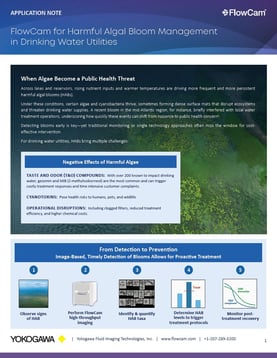
A Practical Approach to Proactive HAB Monitoring for Drinking Water Utilities
HABs are increasing in frequency and persistence, driven by rising nutrients and warming waters. Certain algae and cyanobacteria can produce taste and odor compounds, cyanotoxins, and operational challenges such as filter clogging and increased treatment costs. When monitoring is infrequent or labor-intensive, early bloom development is often missed—forcing utilities into reactive, higher-cost treatment.
This application note describes how flow imaging microscopy (FIM) supports earlier detection and more targeted HAB response by directly imaging and quantifying the organisms driving bloom risk.
Flow Imaging Microscopy for HAB Monitoring
FlowCam® applies flow imaging microscopy to automatically detect, image, measure, and classify algae and cyanobacteria—capturing thousands of particle images per sample in minutes.
Key capabilities include:
📊 Early identification and quantification of HAB-forming taxa
📊 Tracking population shifts and bloom development
📊 Establishing baselines and actionable trigger levels
📊 Creating a permanent, auditable visual record of water quality
Proven Results in Municipal Systems
By integrating FlowCam into its HAB monitoring workflow, the City of Wichita Falls, Texas, achieved earlier detection of bloom-forming cyanobacteria, more precise treatment decisions, a >70% reduction in treatment costs, and near elimination of customer complaints—successfully mitigating more than 25 bloom events.
Download the Application Note
Learn how image-based HAB monitoring helps utilities detect blooms sooner, act more precisely, and reduce operational risk.
Download the application note using the form on this page.