






In our previous posts, we discussed why it is critical to monitor silicone oil droplets in protein therapeutics and explored the new USP guidance emphasizing the need for more sophisticated particle characterization.
This article focuses on the analytical data. Using two study arms, we demonstrate how Flow Imaging Microscopy (FIM) can distinguish silicone oil droplets from protein aggregate particles and apply that classification workflow to stressed prefilled syringe samples.
Download Application Note | Characterizing Subvisible Particles Using FIM
Limitations of Light Obscuration for Silicone Oil and Protein Aggregate Detection
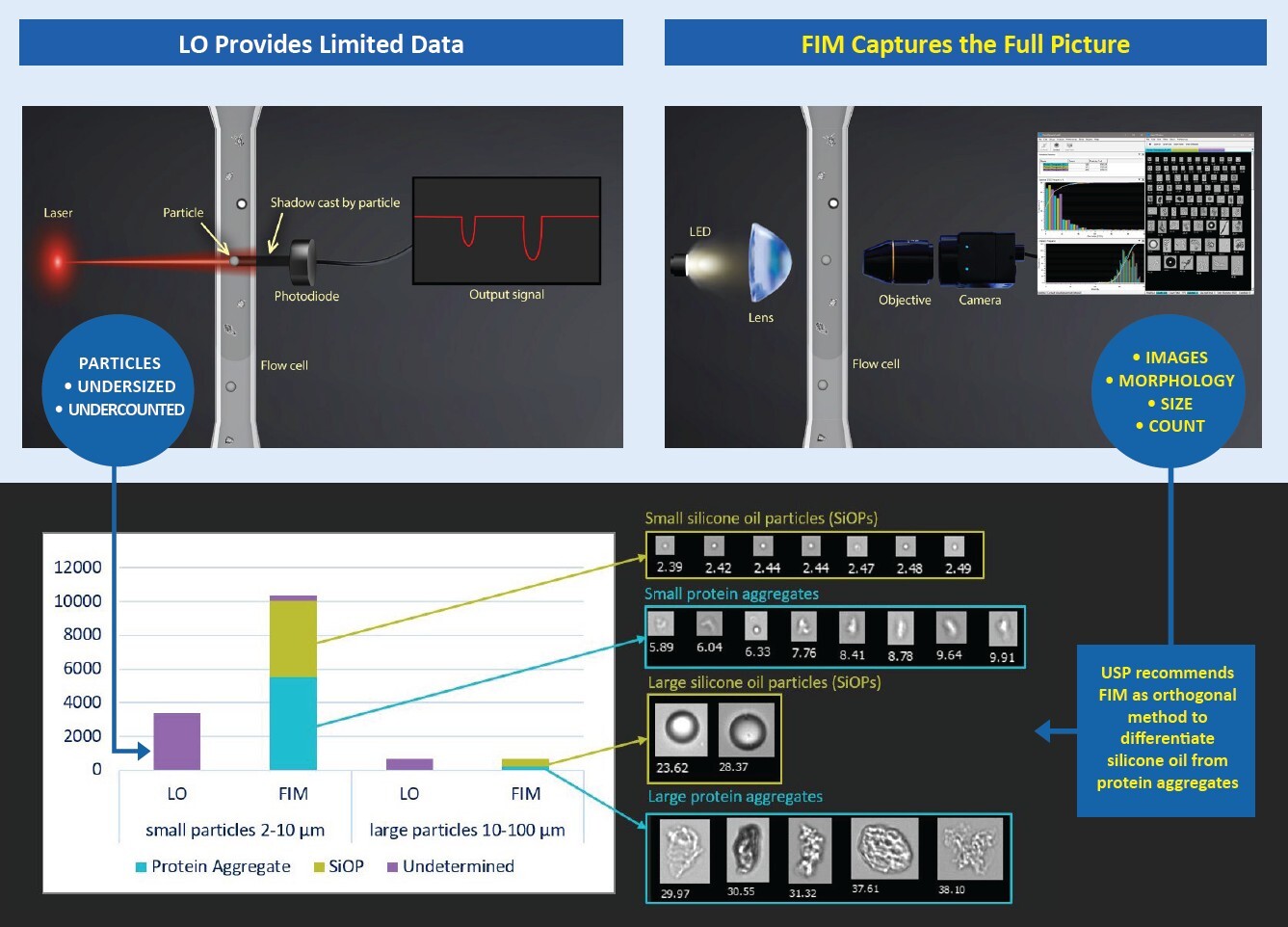
While light obscuration (LO) has long been the compendial standard (USP <788>) for particle analysis in protein therapeutics and other parenteral drugs, it often leaves drug developers and manufacturers in the dark when it comes to the complex, low-contrast subvisible particles (SbVPs) found in modern biologics. Traditional LO works by measuring the shadow a particle casts as it passes a laser. This process is efficient for opaque, high-contrast particles, but protein aggregate SbVPs and silicone oil particles (SiOPs) are often translucent with a low refractive index. Because they don’t block much light, LO frequently undersizes or entirely misses these particles.
FIM captures high-resolution digital images of every particle. Instead of just a shadow, you get a full suite of morphological data—size, count, and shape—that allows you to see exactly what's in your formulation.
Study Arm 1: Differentiating Silicone Oil from Protein Aggregates
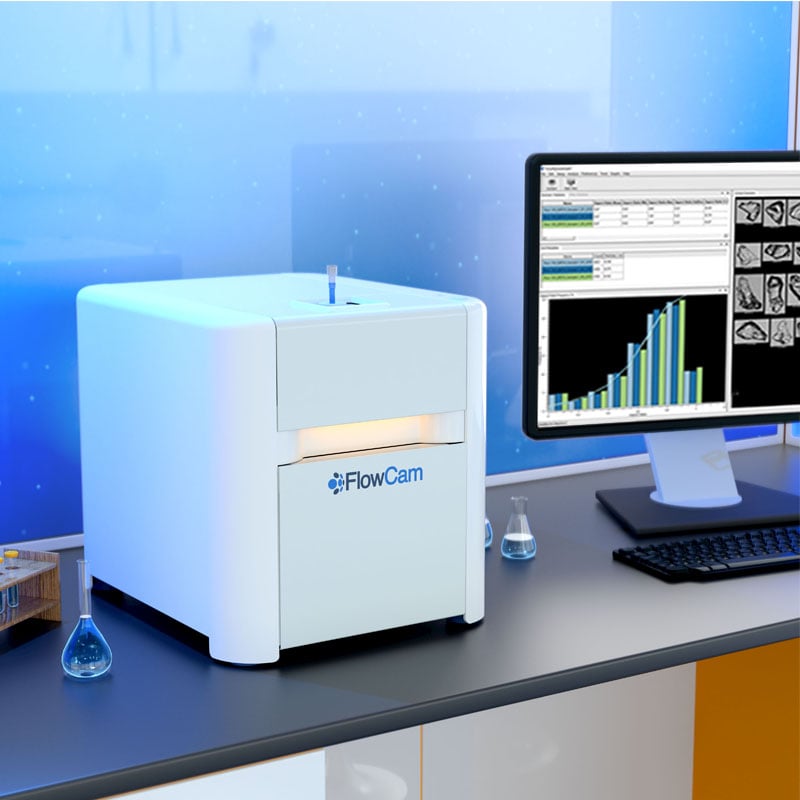
To demonstrate the effectiveness of FIM, we subjected human IgG samples to freeze-thaw stress to create protein aggregate SbVPs and used a "flick method" on siliconized syringes to generate realistic populations of SiOPs. The samples were then analyzed on a FlowCam 8100 instrument.
The results were telling:
- Both protein aggregate SbVPs and SiOPs were most prevalent in the 2–5 µm range.
- Protein aggregate SbVPs trended larger, with ~30% of the population exceeding 5 µm, compared to less than 2% for SiOPs.
- Visual Differentiation: While the two particle types might appear similar to LO, FIM images revealed distinct differences. SiOPs appeared as highly circular with sharp, uniform edges, while protein aggregate SbVPs were typically amorphous and translucent.
Leveraging Flow Imaging Microscopy to Identify Silicone Oil
The real power of FIM lies in its ability to turn images into statistics. Using Cohen’s d (a statistical measure of effect size), we identified which morphological properties were most effective at separating oil from protein aggregate SbVPs. While Circularity, Aspect Ratio, Circle Fit, and Circularity (Hu) all had large effects (Cohen's d values > 0.8), we chose Circle Fit as our primary indicator of roundness, since it had the lowest standard deviation for SiOPs. By building filters based on these properties, FlowCam’s software can be used to automatically classify particles in a mixed sample.
Advanced Characterization: FlowCam Nano for Submicron Silicone Oil Droplets
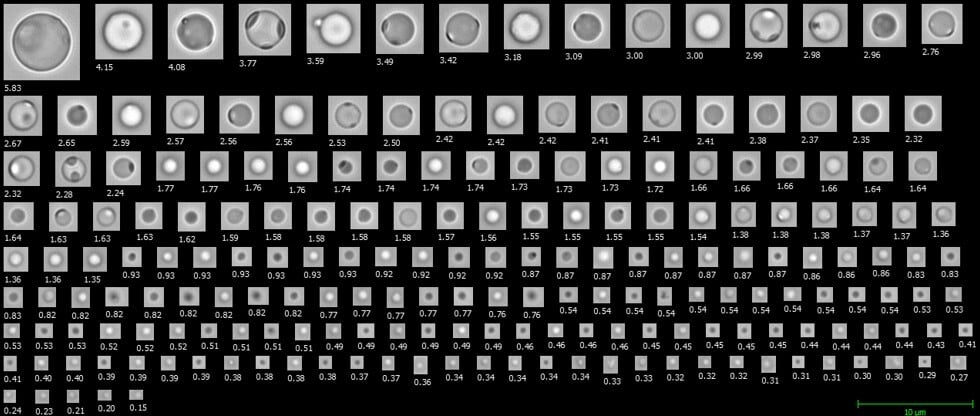
Given that the majority of particles observed were in the 2–5 µm size range, both the protein/hIgG aggregate SbVPs and SiOP references were also analyzed by FlowCam Nano. Its 40X oil-immersion objective revealed detailed textures that are invisible at lower magnifications, such as surface roughness on protein aggregate SbVPs and "bleb-like" features on silicone oil droplets. This level of detail provides invaluable insight into particle behavior and the possible coalescence of SiOPs within a formulation.
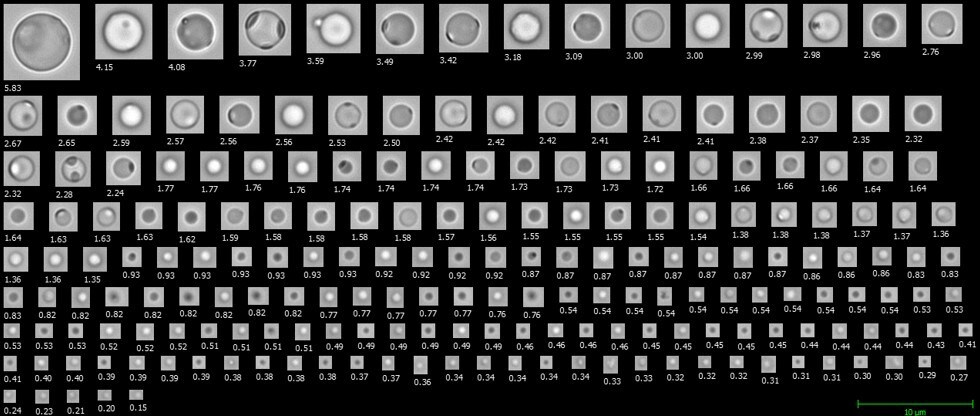
Pictured above: FlowCam Nano images of silicone oil droplets from Study Arm 1
Study Arm 2: Freeze-Thaw Stability in Prefilled Syringes
Study Arm 1 established what the two particle populations look like and how to tell them apart. The second arm of our study applies that classification to a scenario drug product actually encounters in the real world: freeze-thaw stress inside a silicone-oil-lubricated prefilled syringe (PFS).
PFSs have become the preferred primary container for biologics, but they compound the problem. Freeze-thaw stress can drive protein aggregation and silicone oil shedding at the same time, producing exactly the mixed low-contrast populations LO struggles with.
Because PFSs serve as both storage container and delivery device, ICH Q5C and combination-product stability expectations call for freeze-thaw testing in the intended final container-closure system rather than bulk solution alone.
Testing Stress in the Final Container Closure System
For the study, hIgG in PBS solution was loaded into siliconized syringes and subjected to up to three freeze-thaw cycles, with thawing at both room temperature and 4 °C, followed by flicking. Rather than analyzing bulk solution, the contents of each syringe were expelled and run on FlowCam LO, so counts could be reported per container, consistent with USP <788> and <787> limits for small-volume parenterals. Controls were built to isolate each contributor to particle burden: freeze-thaw alone, flicking and storage alone, thaw rate, and silicone oil background in buffer.
What Tandem FIM and LO Revealed
- Where the burden came from: In the size bins that govern compendial outcome, non-round protein aggregates dominated. Round SiOPs stayed concentrated in the smaller 2–5 µm range and contributed comparatively little.
- LO tracked the trend but not the magnitude: LO counts ran consistently lower than FIM counts (as expected for translucent particles), but they rose alongside the FIM data with repeated cycling.
- One measurement, two answers: Because both readings come from the same sample in a single flow path, FlowCam LO pairs compendial LO reporting with the morphological classification that explains where the count came from.
Conclusion: Alignment with USP Guidance for Orthogonal Methods
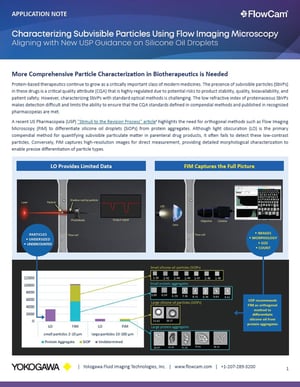 As biologics continue to grow as a class of medicine, the need for independent verification of Critical Quality Attributes (CQAs) has never been higher. FIM doesn't just provide a count; it provides the visual evidence necessary to identify the root causes of particle formation and ensure patient safety. By integrating FIM into your analytical workflow, you move beyond the limitations of LO and align with the latest USP guidance for comprehensive particle characterization.
Download the full application note, Characterizing Subvisible Particles Using Flow Imaging Microscopy: Aligning with New USP Guidance on Silicone Oil Droplets, to see the detailed data and learn how to optimize your particle identification workflow.