

Characterizing Subvisible Particles Using Flow Imaging Microscopy
Aligning with New USP Guidance on Silicone Oil Droplets
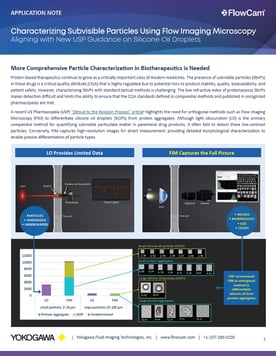
In the evolving landscape of biologics, standard light obscuration (LO) often falls short. Because protein aggregates and silicone oil droplets have a low refractive index, they frequently go undetected—leaving critical particulates undercounted and undersized.
Download this application note to see how Flow Imaging Microscopy bridges the regulatory and technical gaps left by compendial methods.
Why This Research Matters
As prefilled syringes become the industry standard, distinguishing between protein aggregates and the silicone oil used to lubricate these devices is vital to product safety and compliance with emerging regulatory guidelines. This study demonstrates how FIM allows you to:
- Align with new USP guidance: Implement orthogonal methods as recommended by a recent USP stimuli.
- Expose Hidden Particles: Capture high-resolution images of translucent, low-contrast particles that LO misses.
- Automate Classification: Use advanced morphological properties to identify silicone oil droplets vs. other subvisible particles.
Use the form on this page to download the application note.