


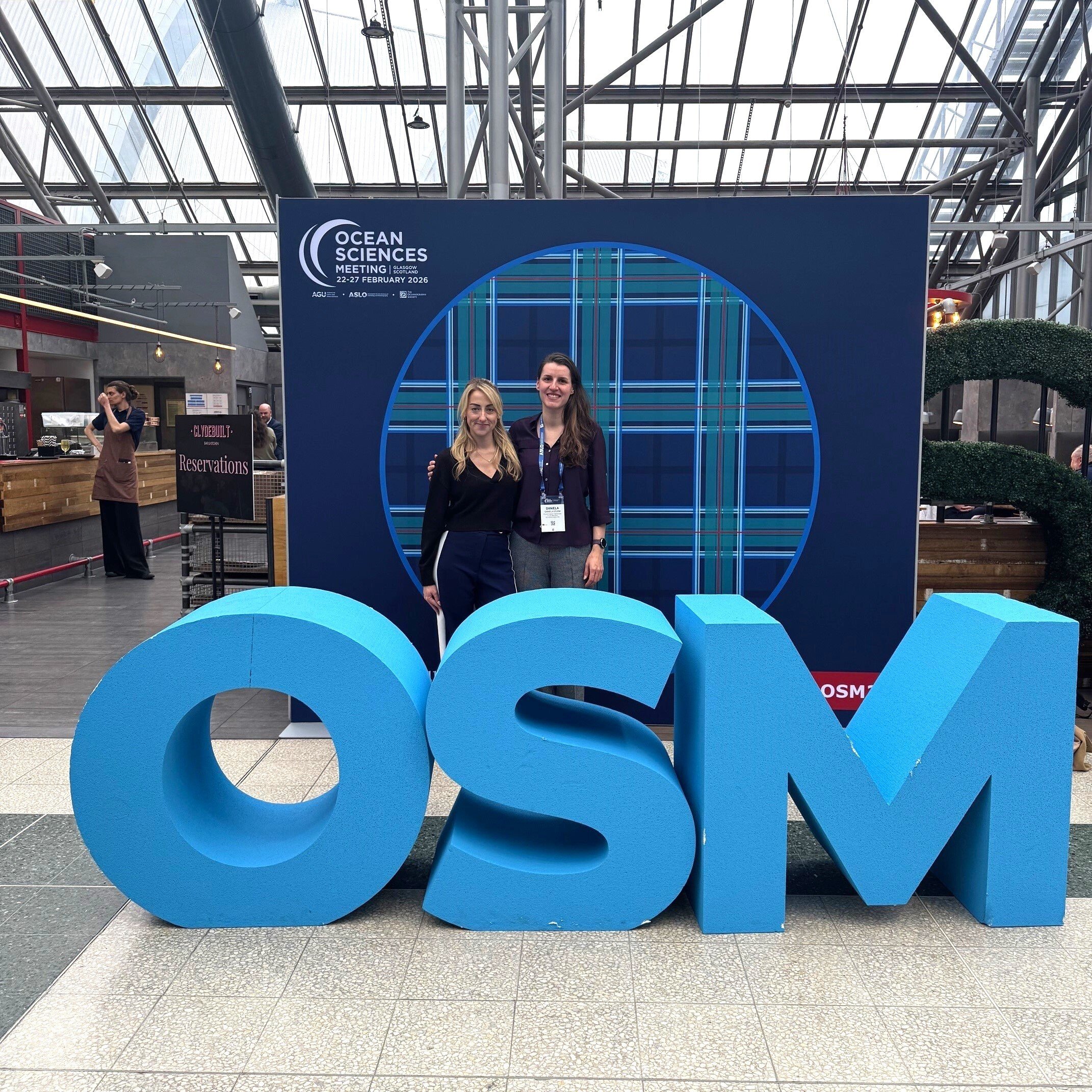
Last week, we attended the Ocean Sciences Meeting (OSM) 2026 in Glasgow, Scotland. OSM is one of the largest international conferences focused on ocean science, bringing together more than 6,000 delegates from around the world. This was also the first time the conference had been held in Europe.
The scale of the event was immediately apparent. The poster hall alone felt like a train station at rush hour, with more than a thousand posters presented throughout the week and researchers constantly moving between sessions, discussions, and the exhibition hall.
One theme stood out across the conference: plankton imaging is becoming a major focus in the field. Multiple sessions and projects highlighted how imaging technologies—including FlowCam—are increasingly used for long-term plankton monitoring worldwide. As researchers look for ways to scale up monitoring and make datasets more reproducible, imaging tools are playing an increasingly important role.
A Workshop on FlowCam Imaging in the Plankton Toolbox
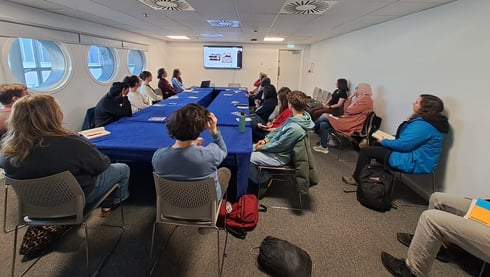
Before the conference officially began, we hosted a workshop on flow imaging microscopy (FIM) and its integration into aquatic research workflows. We clearly underestimated interest—more than 40 people registered, but the room could only accommodate about 20.
Plankton are foundational to aquatic ecosystems, but characterizing them is complex. Researchers often want to know not only which organisms are present, but also their abundance, size, shape, and distribution. Because no single technique captures all of this information, many labs combine complementary approaches.
 |
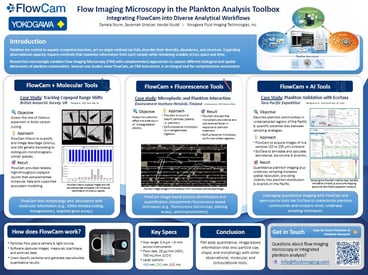 |
(Left) A very busy workshop room with amazing plankton researchers from all over the world. We discussed how FlowCam has been integrated with other analytical tools to get a full picture of their diversity and distribution. You can find a summary and some relevant case studies in the poster we presented at OSM (right). Click to enlarge.
In the workshop, we discussed how FlowCam fits into this broader toolbox. Flow imaging microscopy provides particle-level data—including images, concentrations, sizes, and shapes—that complements techniques such as eDNA metabarcoding, fluorescence and confocal microscopy, AI-based classification, and remote sensing. Together, these approaches help connect species identity, morphology, and ecosystem dynamics.
The workshop was intended for people new to FlowCam and FIM, but the audience included a mix of experience levels from across Europe and beyond. Several current FlowCam users shared their experiences, and many participants noted that imaging approaches could speed up parts of their analysis workflows.
Keshnee from South Africa’s Department of Environment, Forestry and Fisheries joined virtually to share how she uses FlowCam to monitor phytoplankton and microzooplankton, as well as larger zooplankton communities with FlowCam Macro.
We were also joined by Fabien Lombard, from the Laboratoire d'Océanographie de Villefranche (LOV) in France, a long-time FlowCam user involved in several major imaging initiatives, including the Tara expeditions and the development of the EcoTaxa platform for plankton image analysis. It was great to show that our latest software update now enables much easier export of FlowCam datasets directly to EcoTaxa.
Join our upcoming webinar to learn more about integrating FlowCam data with EcoTaxa for quantitative plankton imaging:
Another highlight came from Adam at the University of Gdańsk in Poland, who recently brought an older FlowCam model back into operation. After restoring the instrument, he is already generating new results on Baltic Sea plankton communities. If you have an older FlowCam instrument that you would like to bring back into operation, or if you are interested in learning more about the latest FlowCam systems, please feel free to get in touch.
Posters and Booth Conversations
Once the conference began, the pace only increased. The meeting featured more than 25 posters and presentations using FlowCam data, highlighting the wide range of applications where imaging is now being used. The exhibition hall was busy all week, with a steady stream of visitors at our booth—from researchers who had never heard of FlowCam to long-time users stopping by to say hello.
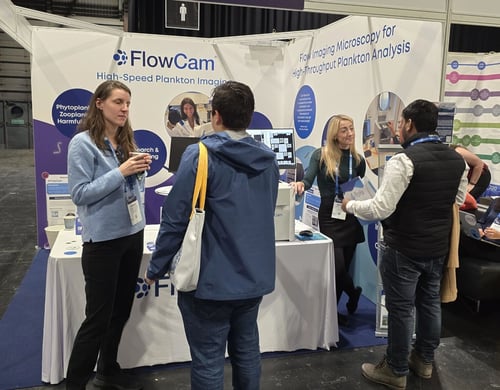 Many conversations focused on phytoplankton and zooplankton diversity and distribution, but the topics extended well beyond that. We spoke with researchers studying benthic macroinvertebrates, sediment particles, microplastics, parasitic interactions in diatoms, and plankton blooms using combined remote sensing and in situ measurements. Shellfish larval characterization also came up frequently.
A few visitors even brought samples for live analysis. Adam from the University of Gdańsk brought a microzooplankton sample to compare results from our newer FlowCam system with his older instrument, and was very impressed with the outcome. We also worked with Ina from the University of Newfoundland, who studies microplastics, to refine her analysis workflow. It was great to troubleshoot together using real samples.
One thing that stood out during the week was how many people shared that they have been using FlowCam for a long time. Several researchers reported that they have had their instruments for more than 10 years and still rely on them regularly.
Catching up with the Plankton Community
For me, one of the best parts of the conference was reconnecting with colleagues from my time in plankton research. I connected with scientists from Woods Hole and Bigelow in the United States, with whom I had previously worked during a research cruise studying how plankton distributions influence the physical and chemical properties of seawater in the Southern Ocean. I also caught up with researchers from the Marine Biological Association in Plymouth and from NORCE in Bergen, where we worked together on coccolithophore ecology.
Seeing former collaborators now using tools like FlowCam in their research is always rewarding. It highlights the continuity between research and technology development – and how the tools we build ultimately become part of the scientific workflows used to understand aquatic ecosystems.
With so much interest in imaging-based approaches throughout the meeting, it was exciting to see how rapidly the field continues to evolve. We are already looking forward to the next Ocean Sciences Meeting!