

Detecting and Identifying Microplastics with Flow Imaging Microscopy
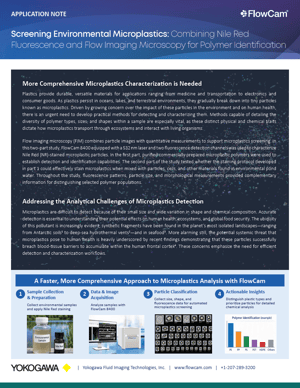 Explore a practical approach to environmental microplastics screening using Nile Red fluorescence and FlowCam.
Microplastics can vary widely in polymer type, size, shape, and chemical composition, making efficient detection and characterization challenging. While techniques such as FTIR and Raman spectroscopy provide detailed chemical identification, they can be time- and resource-intensive when applied to large numbers of particles.
This application note explores flow imaging microscopy (FIM) with FlowCam as a first-tier screening approach, combining Nile Red fluorescence with particle images and quantitative measurements of size and morphology. The method provides complementary information that can help distinguish microplastic populations and identify particles or samples that warrant further chemical analysis.
What you'll learn
Download the application note to see how researchers used FlowCam with Nile Red staining to:
-
Detect and differentiate five purified microplastic polymers, including PET, PS, PP, PE, and HDPE.
-
Combine fluorescence signatures, particle size, and morphology to distinguish polymer populations that could not be separated using fluorescence alone.
-
Apply the workflow to a more complex pond water sample containing six polymer types to evaluate microplastics against a natural environmental particle background.
-
Differentiate Nile Red-stained microplastics from algae based on their fluorescence patterns.
-
Use FIM as a preliminary screening tool before more advanced chemical identification techniques such as FTIR or Raman spectroscopy.
A more comprehensive view of microplastic particles
Rather than relying on a single measurement, FlowCam brings together fluorescence, particle images, size, and shape data. In this study, those complementary measurements provided additional ways to distinguish particle populations, including polymers with overlapping fluorescence responses.
The results demonstrate the potential of Nile Red-assisted FIM as a rapid first step in a microplastics analysis workflow, helping researchers screen complex samples and prioritize particles for further investigation.